


Professional Leak Detection Services in Cypress, TX
Hidden water leaks in Cypress homes cause progressive foundation damage, mold growth, and water bill increases long before any visible signs appear inside the home. The combination of Harris County’s expansive gumbo clay soil, which creates continuous seasonal stress on buried supply lines, and hard water at 120 to 180 parts per million that accelerates internal pipe corrosion makes Cypress one of the highest-risk areas in the Houston metro for slab leaks, underground line failures, and hidden wall leaks. Edmond’s Rooter-Man Plumbers has delivered professional leak detection throughout Cypress and Northwest Houston since 1997, with Texas-licensed technicians verified by the TSBPE, BBB Gold Star accreditation, full general liability and workers’ compensation insurance, and 24/7 emergency detection capability. We use acoustic listening devices, thermal imaging cameras, and electronic moisture meters to locate leaks precisely before any wall or concrete access, protecting your home from unnecessary demolition.
Suspected leak in your Cypress home? Call Edmond’s Rooter-Man Plumbers at 281.351.4422 for professional non-invasive leak detection. Licensed, insured, BBB Gold Star accredited. Available 24/7.
Why Cypress Homes Have Higher Leak Rates Than Most Texas Communities
Three compounding regional factors make leak detection services particularly valuable for Cypress homeowners. First, Harris County’s Black Gumbo clay soil creates a swelling and shrinking cycle with every wet and dry season. When Cypress receives heavy rainfall and clay soil saturates, it expands. During summer months, when temperatures exceed 95°F and rainfall becomes less consistent, that same clay contracts dramatically. Every expansion-contraction cycle applies mechanical stress to buried supply and drain lines at every joint. Pipes that have been through 25 to 40 such cycles, as is common in Copperfield, Fairfield, and Canyon Lakes West, are at significantly elevated risk of joint separation and pinhole failures. The USGS Texas groundwater data documents how regional aquifer conditions and soil characteristics in Harris County interact with residential infrastructure in ways that accelerate plumbing wear.
I am very pleased with the work of your staff
Second, the Cypress municipal water supply delivers hard water at 120 to 180 parts per million of dissolved calcium and magnesium. Every gallon heated inside a water heater or flowing through copper supply lines deposits a fraction of these minerals on interior pipe surfaces. Over years of use, this mineral scaling roughens interior pipe walls and contributes to internal corrosion that weakens the pipe structure from within. Combined with the external mechanical stress of clay soil movement, the dual attack produces pipe failures in Cypress at rates that soft water, stable-soil communities don’t experience.
Third, the housing age of Cypress’s established neighborhoods means the majority of the community’s residential plumbing is operating past or near end of typical service life for the materials installed during construction. Cast iron drain lines in 1980s construction, copper supply lines from the same era, and galvanized steel supply lines in pre-1985 homes are all at various stages of corrosion-driven failure risk. Slab leaks in Cypress peak during the June through August period when soil contraction from summer heat is most pronounced, the same seasonal pattern that drives the hot floor spots that signal slab leaks throughout the Houston metro during summer months.
Advanced Leak Detection Technology We Use in Cypress
Acoustic Listening Devices
Pressurized water escaping through a crack or pinhole produces a distinctive frequency pattern when the surrounding material is placed under acoustic analysis. Our listening devices amplify this sound pattern far above ambient noise levels, allowing technicians to hear it through concrete slabs, soil, and building materials. By comparing sound levels at multiple contact points across the suspected area, we triangulate the leak location to within inches, without opening any surfaces until the location is confirmed.
Thermal Imaging Cameras
Thermal imaging creates a visual temperature map of wall and floor surfaces. A leaking hot water pipe beneath a Cypress home’s concrete slab creates a warm zone that registers clearly against the cooler surrounding slab. Cold water leaks appear as cooler-than-surrounding-surface patterns. Thermal imaging confirms acoustic findings, maps the extent of moisture spread from the confirmed leak point, and identifies secondary moisture areas that may indicate additional damage beyond the primary leak location.
Electronic Moisture Meters
Electronic moisture meters measure the water content percentage in drywall, wood framing, concrete, insulation, and flooring materials. Readings above normal baseline levels identify areas where moisture has migrated from the leak source, providing a map of secondary damage scope that determines whether drywall, insulation, or subfloor materials require remediation in addition to the plumbing repair itself.
Pressure Testing
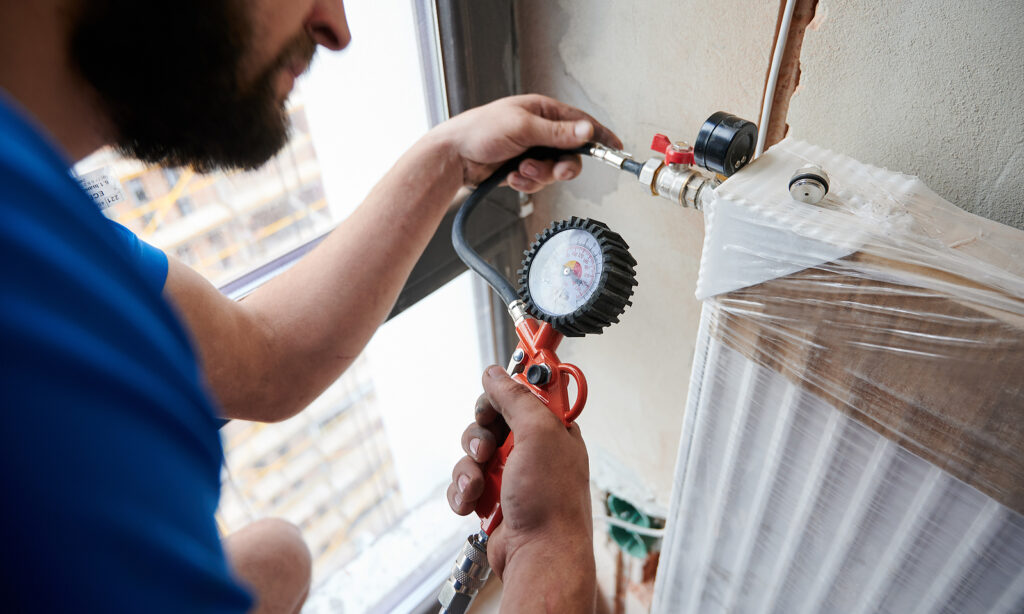
Pressure testing isolates specific pipe circuits by closing valves and pressurizing the isolated section to a test pressure, then monitoring for pressure drop over a set time period. Any pressure drop confirms a breach within the isolated circuit. This test helps focus acoustic and thermal scanning on the specific circuit with confirmed pressure loss, improving efficiency when the leak location is not immediately apparent from symptom pattern alone.
Video Camera Inspection
For sewer line breach investigations, waterproof camera inspection examines the interior of drain and sewer lines, revealing root intrusion points, cracked sections, pipe offset from soil movement, and joint separations that produce the wet yard patches and sewage odors associated with sewer line leaks. Camera inspection findings are integrated with our sewer line repair service to provide a complete picture of the condition requiring repair.
Types of Leaks We Detect in Cypress, TX
Slab Leak Detection
Slab leaks, failures in water supply lines running beneath the concrete foundation, are the most common serious leak type in Cypress due to the clay soil conditions and housing age combination. Both hot water slab leaks (identifiable by warm floor spots) and cold water slab leaks (detectable through water meter testing and moisture mapping) require professional acoustic and thermal detection equipment to locate precisely. Our detection process provides the leak’s location to within inches before any concrete access is made.
Underground Main Line Leak Detection
Main water line leaks between the Cypress Street meter and the home produce uniformly low water pressure throughout the house, often accompanied by wet soil or unusually green grass in the yard above the line route. We deploy acoustic ground microphones that filter ambient noise to isolate the distinctive sound of water escaping underground, pinpointing the leak location for minimal excavation repair. Our water main repair service coordinates detection and repair.
Wall and Ceiling Leak Detection
Hidden leaks inside wall cavities and above ceilings damage wood framing, insulation, drywall, and flooring long before staining or dampness becomes visible from inside the home. Our thermal imaging and moisture metering combination identifies the leak source location and maps the full extent of moisture spread within the cavity, so repairs address both the plumbing failure and the secondary building material damage without opening more wall than necessary.
Irrigation System and Foundation Perimeter Leak Detection
Irrigation system leaks near the foundation perimeter are particularly damaging for Cypress homes because they saturate the clay soil at the point most critical to foundation stability. A leak at the foundation perimeter creates a zone of consistently saturated clay while surrounding soil remains at its seasonal moisture level, precisely the differential condition that causes slab movement. Early detection of irrigation system leaks near the foundation is the single most effective step for reducing foundation movement risk.
What to Expect During a Cypress Leak Detection Service Call
- Symptom consultation: We gather information about water bill patterns, floor temperature variations, water meter behavior, and any visible symptom locations before entering the home.
- Water meter test: We confirm active water loss is present before positioning detection equipment, eliminating the possibility that billing anomalies have a different explanation.
- Pressure isolation test: We isolate hot and cold water circuits separately to confirm which system, supply or drain, hot or cold, is experiencing the loss.
- Acoustic scanning: Listening equipment is applied methodically across the suspected area, comparing signal strength at multiple points to identify the strongest signal location.
- Thermal and moisture mapping: Thermal imaging and moisture meters confirm the acoustic finding and map the secondary moisture spread area beyond the primary leak point.
- Camera inspection for sewer concerns: When sewer line involvement is suspected, camera inspection examines interior pipe conditions at the confirmed area of interest.
- Findings presentation: We explain all findings clearly with the ability to show you thermal images, moisture meter readings, and the specific location identified before any repair discussion begins.
- Repair options: Based on confirmed findings, we present repair options with honest explanations of what each involves, the access required, and the expected result before any work is authorized.
Why Cypress Homeowners Choose Edmond’s Rooter-Man Plumbers for Leak Detection
| What We Offer | What It Means for You |
| Texas-Licensed Plumbers (TSBPE Verified) | All leak detection and repair work in Cypress is performed by TSBPE-licensed plumbers, ensuring code compliance on every repair following detection and protecting your home’s insurance coverage. |
| BBB Gold Star Recipient | Nearly 30 years of verified customer satisfaction in Cypress and Northwest Houston. The same detection accuracy and honest repair recommendations on every service call. |
| Fully Insured, GL + Workers’ Comp (About Our Company) | Complete liability and workers’ compensation coverage protects you from any liability during leak detection work and all subsequent repairs on your Cypress property. |
| Acoustic + Thermal + Moisture Detection (Leak Detection) | We use three non-invasive detection methods together, acoustic listening, thermal imaging, and electronic moisture meters, to triangulate leaks to within inches before any access work begins. |
| No-Guess Access, Precise Before We Open Anything (Hot Spots Blog) | We never open walls or cut concrete based on guesswork. Detection findings are confirmed before access begins, ensuring the opening is at the confirmed leak site and repair scope is accurate from the start. |
| Slab Leak Specialists in Cypress (Sewer Line Repair Cypress) | Slab leaks from Harris County’s clay soil are the most common serious leak type in Cypress. Our technicians understand the specific soil and pipe conditions driving local slab leak patterns and diagnose them efficiently. |
| 24/7 Emergency Leak Response (Emergency Plumbing Cypress) | Active water damage situations receive immediate priority dispatch. Emergency leak detection includes same-call findings so water can be shut off at the correct valve before full damage assessment is completed. |
| Insurance Documentation Support (Contact Us) | Written findings, photos of confirmed leak locations, and detailed service reports support homeowners insurance claims for covered water damage events. Accurate documentation before cleanup protects your claim. |
Need leak detection for your Cypress home? Call 281.351.4422 for professional non-invasive leak location. Edmond’s Rooter-Man Plumbers, BBB Gold Star accredited, licensed, insured, available 24/7.
Areas Near Cypress We Also Serve for Leak Detection
Edmond’s Rooter-Man Plumbers provides professional leak detection throughout Cypress and the surrounding Northwest Houston region. In addition to all Cypress communities, we serve Tomball, Spring, The Woodlands, Magnolia, Conroe, and Jersey Village. Visit our cities we serve directory for complete service area information.
Frequently Asked Questions About Leak Detection in Cypress, TX
Why are leak detection services especially important for Cypress homes?
Cypress homes face a specific combination of conditions that make hidden leaks both more common and more consequential than in most Texas communities. Harris County’s expansive gumbo clay soil creates seasonal pipe stress that causes joint failures in buried supply lines. Hard water at 120 to 180 parts per million accelerates internal pipe corrosion. And 68 percent of Cypress homes were built before 2000, meaning most residential plumbing is now 25 to 45 years old and approaching or past typical service life.
What types of leaks can you detect in Cypress properties?
We locate water line leaks beneath concrete slab foundations, underground main line leaks between the street meter and the home, leaks inside wall cavities and above ceilings, supply line leaks behind fixtures, sewer line breaches, and irrigation system leaks near the foundation perimeter. Both residential and commercial properties throughout Cypress receive the same non-invasive detection capabilities.
What are the warning signs of a slab leak in my Cypress home?
The most recognizable warning signs of a slab leak in a Cypress home are a floor area that feels noticeably warm underfoot from a hot water line leaking beneath the slab, a water meter that keeps moving when all fixtures are off, unexplained water bill increases of 20 percent or more without usage changes, new cracks developing around door frames or windows from foundation movement, wet or damp carpet with no surface source, and a water heater that cycles repeatedly without apparent hot water use.
How does Harris County’s clay soil contribute to slab leaks in Cypress?
Harris County’s expansive Black Gumbo clay swells significantly when saturated during wet seasons and contracts sharply during summer drought periods. This repeated swelling and shrinking creates lateral mechanical stress on buried supply lines at every joint and connection point. After 20 to 40 years of repeated stress cycles, joints separate and pipe walls develop fatigue cracks, particularly at bends and fittings where the pipe material is already under structural loading.
What technology does Edmond’s Rooter-Man use for leak detection in Cypress?
We use acoustic listening devices that amplify the distinctive frequency of pressurized water escaping through a crack or pinhole, thermal imaging cameras that create a visual temperature map revealing moisture patterns beneath floor surfaces and inside walls, and electronic moisture meters that measure water content in building materials including drywall, wood, concrete, and insulation. Pressure testing isolates specific pipe circuits when acoustic and thermal methods need to be supplemented with system-level data.
How does acoustic leak detection work?
Pressurized water escaping through a crack or pinhole produces a distinctive sound frequency that acoustic listening devices amplify far above the ambient noise level. By placing the sensor at multiple access points across the suspected area, drain cleanouts, hose bibs, and direct floor contact points, our technicians compare the relative sound intensity to triangulate the precise leak location to within inches of its actual position beneath the slab or inside the wall.
What is thermal imaging and how does it detect leaks in Cypress homes?
Thermal imaging cameras detect temperature differences across wall and floor surfaces. A leaking hot water pipe beneath the slab or inside a wall creates a warm zone that registers clearly against the cooler surrounding material. Cold water leaks show as cooler-than-surrounding-surface areas. Thermal imaging confirms acoustic findings and maps the extent of moisture migration from the leak point, which is critical for determining the full scope of damage beyond the leak location itself.
How long does a leak detection inspection take in Cypress?
Most residential leak detection inspections complete within one to three hours depending on home size, the complexity of the plumbing system, and how many potential leak areas require evaluation. Larger homes or situations involving multiple suspected leak zones may require additional time. We conduct the full assessment before beginning any access work, so you receive accurate findings before any repair decision is made.
Can you detect a leak without breaking my floors or walls?
Yes. Our detection sequence uses acoustic listening devices, thermal imaging, and moisture meters to locate leaks precisely before any surface access occurs. Access work happens only at the confirmed leak location, not based on guesswork or exploratory demolition. This precision means the access opening is typically small and targeted rather than a large section of floor or wall opened speculatively.
How does Cypress hard water make homes more susceptible to pipe leaks?
Tomball and Cypress municipal water carries 120 to 180 parts per million of dissolved calcium and magnesium. These minerals deposit inside copper and galvanized steel supply lines as scale, roughening interior pipe walls and contributing to internal corrosion that progressively weakens pipe wall integrity. Combined with the mechanical stress of Harris County’s clay soil movement, the dual attack of mineral corrosion from within and soil stress from without creates the conditions for pipe failures at a rate higher than in soft water, stable-soil areas.
What happens to a Cypress home’s foundation if a slab leak goes undetected?
Ongoing water from a slab leak saturates the gumbo clay beneath the foundation. Saturated clay swells in a non-uniform pattern, more beneath the leak than in surrounding areas, creating differential soil volume change that lifts one section of the slab while others remain stable. This differential movement produces the visible symptoms of advanced slab leak damage: door and window frames that stick or no longer close correctly, new diagonal cracks in drywall at corners, and visible separation at wall and ceiling junctions.
How do I check for a hidden water leak myself before calling a professional?
The water meter test provides the clearest self-check available. Shut off every fixture, appliance, ice maker, and irrigation zone in your home. Find your water meter at the curb and watch the low-flow indicator or dial for 15 minutes with everything confirmed off. Any movement of the indicator confirms active water loss somewhere in your system. This test does not locate the leak but confirms one exists, and confirms whether professional detection equipment is needed.
What causes underground water line leaks in Cypress homes?
Underground main line leaks between the Cypress street meter and the home result from a combination of galvanized steel or aging copper pipe corrosion, root intrusion from the neighborhood’s mature live oak and water oak trees reaching the supply line, clay soil settlement that creates stress at the point where the line enters the foundation, and ground vibration from heavy vehicle traffic on nearby streets gradually fatiguing older pipe wall materials.
How much water can a hidden slab leak waste in Cypress?
A moderate slab leak at typical Cypress supply pressure of 60 to 80 PSI can lose 50,000 to 100,000 gallons before detection. At Cypress water rates, that volume represents substantial additional cost on utility bills. The secondary cost of foundation damage from the soil saturation that accompanies undetected slab leaks typically far exceeds the water cost, foundation repair in Harris County can range from several thousand dollars for localized cracking to tens of thousands for differential settlement repair.
Can I tell if I have a water leak just by looking at my water bill?
A water bill that has increased by 20 percent or more without corresponding usage changes is a strong indicator of active hidden water loss. However, water bills are monthly snapshots, a moderate slab leak that has been running for several weeks may not produce dramatic per-month changes until the leak has wasted significant volume. The water meter test provides a real-time confirmation that can identify active leaks that billing data alone would take weeks to reveal.
What repair options are available after a leak is detected in Cypress?
After detection, repair options are selected based on pipe material, leak location, pipe age, and overall system condition. Spot repair involves targeted concrete or wall access at the confirmed leak site to replace the failed section. Pipe rerouting bypasses the damaged underground section by running a new supply line through wall cavities, avoiding concrete work. Epoxy pipe lining coats the interior of intact pipes to seal pinhole leaks. Our licensed technicians present all options before any work begins.
Is a slab leak detection call an emergency in Cypress?
Yes. Even a slow slab leak should be treated with urgency. Water loss from a slab leak is continuous, compounding the soil saturation beneath the foundation with every passing day. Early emergency response prevents a repairable slab leak from progressing into a foundation repair situation. When a Cypress homeowner calls with confirmed slab leak symptoms, warm floor spots, water meter movement, rising bills, we treat the call as priority regardless of the current symptom severity.
How do Cypress’s older neighborhoods affect leak detection service volume?
Copperfield, Fairfield, Canyon Lakes West, and Stone Gate, developed primarily in the 1980s, account for the highest volume of leak detection service calls in Cypress due to their combination of aging copper supply lines, original cast iron drain systems, and the most established tree canopy sending roots toward moisture sources. Newer communities like Bridgeland, Towne Lake, and Marvida with PVC plumbing systems experience lower leak detection call rates but are not immune to slab movement and underground line failures.
Do you offer emergency leak detection in Cypress for active water damage situations?
Yes. When visible water intrusion from an unidentified source is actively damaging a Cypress home, we dispatch with full acoustic and thermal detection equipment for immediate same-call detection and diagnosis. Emergency detection combined with water shutoff at the correct valve stops active loss before the repair scope is finalized. Our 24/7 emergency line connects to dispatch rather than an answering service, ensuring genuine emergency response availability.
Will my homeowners insurance cover hidden water leak damage in Texas?
Standard Texas HO-3 policies typically cover sudden and accidental water damage from hidden leaks, damage to flooring, walls, and contents. The plumbing repair itself is often excluded as a maintenance item. Gradual leaks that developed over extended periods are sometimes denied. Document all damage with photos immediately and contact your insurer before any cleanup. Our detailed service reports and written findings support insurance claim documentation.
How often should Cypress homeowners schedule professional leak inspections?
Homes over 20 years old in Cypress benefit from professional leak inspection every three to five years given the combination of hard water chemistry and clay soil conditions. Homes with a history of confirmed leaks, recent unexplained water bill increases, or foundation movement warrant more frequent inspection. An annual water meter self-test provides a meaningful interim check between professional inspections.
Can you detect sewer line leaks in addition to water supply line leaks in Cypress?
Yes. Sewer line breaches manifest differently from water supply leaks, they typically produce wet or unusually green areas in the yard above the line route, sewage odors outside the home, and slow or gurgling drains inside. We use video camera inspection to examine sewer line interior condition and pressure testing to confirm breach locations. Sewer line detection and repair coordination are handled by the same licensed team.
What is the difference between leak detection and leak repair?
Leak detection is the diagnostic process of locating a hidden leak using specialized equipment, acoustic devices, thermal cameras, moisture meters, and pressure testing. Leak repair is the physical correction of the confirmed failure. At Edmond’s Rooter-Man Plumbers, the same licensed team performs both detection and repair. Detection findings are explained clearly before any repair work begins, so homeowners understand the location, cause, and recommended repair approach before authorizing work.
Why should I choose Edmond’s Rooter-Man for leak detection in Cypress?
Edmond’s Rooter-Man Plumbers has served Cypress and Northwest Houston since 1997 with Texas-licensed technicians who understand the specific leak risk factors of Harris County’s clay soil, Cypress’s hard water conditions, and the aging infrastructure of pre-2000 Cypress neighborhoods. Our acoustic, thermal imaging, and moisture meter capabilities locate leaks precisely before any access work begins. BBB Gold Star accreditation, full insurance coverage, and 24/7 emergency response are standard on every detection call. Call 281.351.4422 for professional leak detection in Cypress.
Protect Your Cypress Home, Call Edmond’s Rooter-Man Plumbers for Leak Detection
Hidden leaks in Cypress homes cause more total damage per event than almost any other plumbing failure type because they compound silently, foundation movement, mold growth, and water loss all accumulate before a homeowner has any obvious indication that something is wrong. The right time to investigate is when early warning signs appear, not after visible damage confirms what non-invasive detection would have found months earlier.